
Exploring Greenwich Village: A Daughter’s Lens on New York’s Historic Heart
About a month ago, I embarked on a nostalgic journey to Greenwich Village, the vibrant neighborhood that houses my alma mater, New York University. While I was captivated by the architectural grandeur and the echoes of my student days, my daughter, with her keen artistic eye, captured some truly remarkable photographs. It’s her unique perspective that I’m thrilled to share with you today, offering a fresh look at the captivating corners of New York’s iconic Greenwich Village.
Truth be told, she’s undoubtedly the more talented photographer in our household, and her images beautifully highlight some of the most interesting sights and hidden gems scattered throughout this historic Manhattan enclave. Join us as we wander through the enchanting streets, uncovering the charm and history that define this beloved district.
Grace Church: A Gothic Revival Masterpiece on Broadway
Our stroll down Broadway led us past the magnificent Grace Church, a structure that immediately commands attention. With its awe-inspiring French Gothic Revival architecture, especially before the full splendor of spring blossoms, it possesses a certain dramatic, almost haunting quality. It’s truly remarkable to find such a grand and historically significant edifice nestled right in the bustling heart of Manhattan, making it a surprising and captivating sight for both locals and visitors alike.
Constructed between 1843 and 1846, Grace Church was designed by James Renwick Jr., who would later design St. Patrick’s Cathedral. Its design is a superb example of the Gothic Revival style, characterized by pointed arches, ribbed vaults, and ornate tracery. The church’s intricate stonework and towering spires evoke a sense of timeless European charm, standing in stark contrast to the modern skyscrapers that dominate the surrounding cityscape. Its presence underscores Greenwich Village’s rich historical tapestry and its ability to surprise at every turn.
Gazing upon its imposing doors, adorned with exquisite details and craftsmanship, it’s no wonder that Grace Church holds the esteemed title of a National Historic Landmark. These doors are not merely entryways; they are works of art, inviting contemplation and admiration for the skilled artisans who brought this architectural vision to life. They symbolize the enduring legacy of faith and artistry that permeates Greenwich Village’s historical landscape, drawing countless photographers and history enthusiasts.
The Cooper Union: A Beacon of Innovation and Free Education
Continuing our exploration, we soon arrived at one of my personal favorites: The Great Hall at Cooper Union. This world-renowned institution stands as a testament to pioneering education in Art, Architecture, and Engineering, and its building itself is an architectural marvel. Built in 1859, the brownstone edifice is steeped in history and innovation. Remarkably, it featured an elevator shaft even before the invention of practical passenger elevators, showcasing Peter Cooper’s forward-thinking vision.
The Great Hall holds immense historical significance. It was here, in 1860, that Abraham Lincoln delivered his pivotal “Right Makes Might” speech, a powerful address that significantly bolstered his presidential campaign and helped shape the course of American history. This magnificent hall has hosted countless other influential figures and debates, cementing its status as a vital forum for intellectual discourse and social change.
Perhaps one of Cooper Union’s most celebrated legacies is its commitment to accessible education. Until 2014, it proudly offered free tuition to all its students, a radical concept that allowed exceptional talents, regardless of their economic background, to pursue their passions. This dedication to equality in education continues to define the institution’s spirit, even as it navigates modern financial realities. Like Grace Church, Cooper Union is also recognized as a National Historic Landmark, a fitting tribute to its profound impact on education, architecture, and American society.
Astor Place: Modern Architecture Meets Historic Charm
Directly across the street from the venerable Cooper Union stands a striking contrast: the Astor Place building. Known for its distinctive undulating facade, this residential high-rise takes its name from the historic area it inhabits. While its contemporary design might seem at odds with the surrounding historical structures, it represents the dynamic evolution of Greenwich Village, where old and new frequently converge in fascinating ways.
The Astor Place building, designed by Charles Gwathmey, is a significant example of modern architecture in the area. Its wave-like structure and shimmering glass exterior make it a prominent feature of the local skyline, drawing eyes with its bold presence. While undoubtedly a beautiful piece of design, it’s safe to say that residences within this architectural marvel are, unfortunately, well beyond my budget. It stands as a symbol of Greenwich Village’s continued desirability and its blend of diverse architectural styles.
The Merchants Building (693 Broadway): Ornate Details in NoHo
Located at the intersection of West 4th Street and Broadway, the building at 693 Broadway is officially known as the Merchants Building. This magnificent structure exemplifies a style common to many buildings constructed along Broadway during its heyday – an abundance of ornate sculptures and intricate detailing. In this particular instance, the facade is richly embellished with figures of owls and lions, which become even more discernible upon closer inspection towards the base of the building.
The Merchants Building, dating back to the late 19th century, reflects the commercial grandeur and artistic flourishes prevalent in New York City’s architecture of that era. Its detailed carvings serve as a historical record, showcasing the craftsmanship and aesthetic values of a bygone era. A more recent, yet striking, addition to the building is its vibrant blue cornice, which not only enhances its visual appeal but also plays a practical role in the building’s drainage system, harmoniously blending modern functionality with historical charm.
Technically speaking, this area is distinct from what many consider the core of Greenwich Village; it’s known as NoHo, an acronym for “North of Houston Street.” This neighborhood, much like its southern counterpart, SoHo (South of Houston), is a designated National Landmark district. Both NoHo and SoHo are celebrated for their preservation of numerous historic buildings, characterized by their cast-iron facades and unique architectural styles, making them living museums of New York City’s rich past. While our adventure didn’t extend into SoHo on this particular day, NoHo offered a captivating glimpse into this remarkable architectural heritage.
Washington Square Park: The Vibrant Heart of Greenwich Village and NYU
No journey through Greenwich Village is complete without spending time in Washington Square Park, truly the pulsating heart of the neighborhood and the de facto campus of New York University. I use the term “campus” rather loosely here, as NYU famously boasts an “open campus” with academic buildings and dormitories integrated seamlessly throughout various parts of New York City, making the park a central gathering point rather than a bounded academic area.
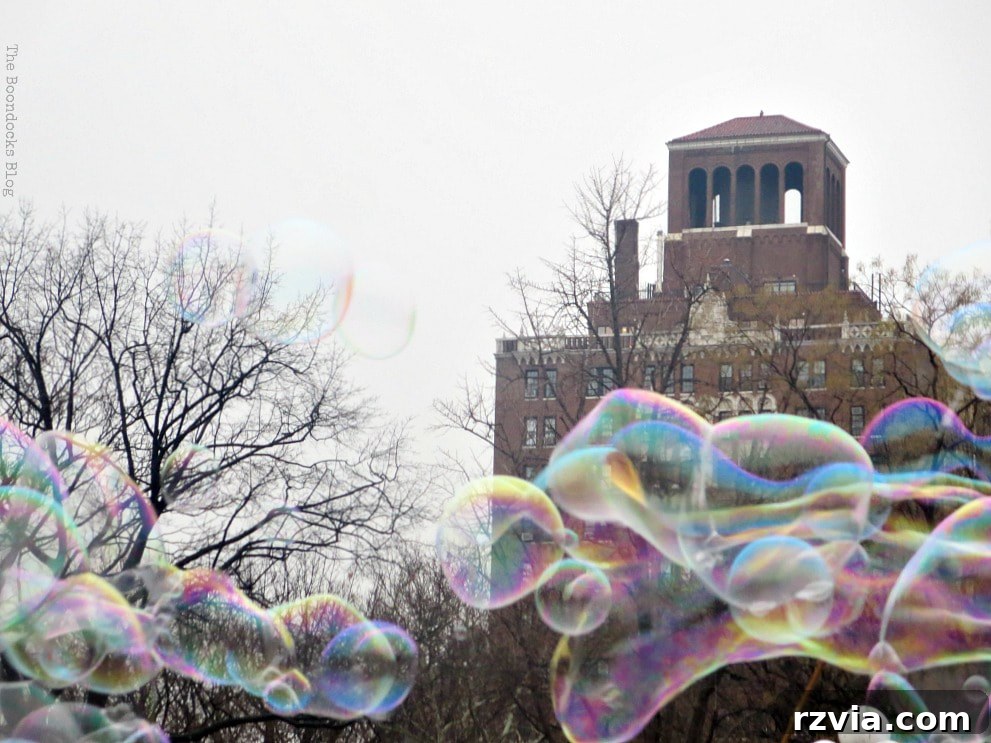
The park is a vibrant melting pot, serving as a dynamic meeting place for NYU students, local residents, and a diverse array of artists and performers eager to share their creativity with the world. On the particular cold and rainy spring day of our visit, the park was still alive with activity. We witnessed a fascinating scene: a talented street artist skillfully blowing giant, shimmering bubbles that drifted gracefully across the open space, creating a magical spectacle against the backdrop of NYU’s Lipton Hall Dormitory. This impromptu performance perfectly encapsulated the park’s bohemian spirit and its role as a stage for spontaneous artistry and community interaction, despite the inclement weather.
Washington Square North and the Hidden Mews
Just across the northern edge of Washington Square Park, you’ll discover a row of exquisite early 19th-century townhouses. These elegant residences are prime examples of the Greek Revival architectural style, characterized by their classical proportions, stately columns, and refined detailing. Washington Square North, once private homes, are now largely owned and utilized by NYU, serving various academic and administrative functions while retaining their historical charm.
These stately homes line one of the most prestigious blocks in the city, offering a glimpse into the opulent past of New York’s elite. Their grand doorways and symmetrical facades are a photographer’s delight, each telling a story of centuries past. The careful preservation of these buildings ensures that the architectural heritage of Greenwich Village remains intact, providing a beautiful historical context to the modern vibrancy of the park.
Tucked away behind these magnificent row houses lies the charming Washington Mews. Once serving as stables and carriage houses for the grand residences of the area, the Mews have been beautifully converted into quaint, private homes and studios, retaining their cobblestone charm and secluded atmosphere. Between the row houses and the Mews, there’s a lovely, often overlooked courtyard, and it was here that we stumbled upon a delightful treasure:
A striking statue of Miguel Cervantes, the celebrated Spanish writer and creator of the iconic Don Quixote. This unexpected find adds a touch of European literary history to the heart of Greenwich Village, reminding visitors of the diverse cultural influences that have shaped New York City. The tranquil courtyard, with its hidden statue, offers a peaceful respite from the urban buzz, a true secret garden in plain sight.
The Iconic Washington Square Arch: A Gateway to Fifth Avenue
Turning our gaze north from the park, we were greeted by the majestic Washington Square Arch, an undeniable icon of New York City. This grand marble triumphal arch was erected to commemorate the centennial of George Washington’s inauguration as president in 1789. It also serves as the impressive southern terminus of Fifth Avenue, one of the world’s most famous and upscale thoroughfares. The elegant row houses, particularly those on Washington Square North, stand proudly to the right of the arch, framing this significant landmark beautifully.
This particular photograph was captured during a period of construction on Fifth Avenue, providing a unique perspective. Standing directly beneath the magnificent arch and looking northward, one can appreciate the impressive scale of Fifth Avenue stretching into the distance. The arch itself, modeled after Paris’s renowned Arc de Triomphe, was completed in 1892. It reaches a height of 77 feet, with its grand arch opening spanning 47 feet, a testament to the ambitious architectural aspirations of the era.
The arch’s design, inspired by classical Roman and French precedents, is adorned with intricate carvings and sculptures that celebrate American history and ideals. Its imposing presence serves not only as a beautiful monument but also as a powerful symbol of national pride and the enduring legacy of George Washington. It has become a cherished landmark, instantly recognizable as a symbol of Greenwich Village and New York City at large, a popular spot for gatherings, protests, and everyday life.
Disclosure: The items below are affiliate links. If you purchase any of these products through the links, I receive a small commission, which helps me continue to provide you with lovely content. There is no extra charge to you for purchasing through my affiliate links.
Flanking the north side of the arch are two significant statues of George Washington, each depicting a different aspect of his monumental life. The one pictured below is Washington at War, a powerful portrayal of him as a military leader, reflecting his crucial role in the American Revolution. This sculpture captures a sense of determination and command, embodying the spirit of a nation fighting for its independence.
Complementing it is the statue of Washington at Peace, which depicts him in a more statesmanlike role, symbolizing his leadership during the formation of the young republic. Both these significant bronze sculptures were added to the arch in 1918, enhancing its narrative and offering a comprehensive tribute to the nation’s first president. Together, they provide a powerful visual representation of Washington’s dual legacy as both a military hero and a foundational leader.
Ai Weiwei’s “Good Fences Make Good Neighbors” Exhibition
During our visit, the statues were flanked by a remarkable contemporary art installation titled “Good Fences Make Good Neighbors,” created by the internationally renowned Chinese artist Ai Weiwei. This thought-provoking exhibition featured a striking 37-foot steel cage, which integrated a reflective, amoeba-shaped passageway that we had the opportunity to walk through. The installation was part of a citywide project by the Public Art Fund, addressing themes of borders, identity, and the refugee crisis.
Ai Weiwei, known for his activism and powerful commentary on human rights and freedom of expression, used this installation to challenge perceptions of security, division, and the very concept of “neighbors.” Its presence at such a historic and publicly accessible site as Washington Square Arch created a compelling dialogue between classical monument and contemporary critique. It was a powerful reminder of how art can provoke reflection on pressing global issues within an urban landscape.
I’m including a video of the citywide exhibition here, for those who wish to experience its scope and impact. And for more information on the artist and his vision, you can find a link to his work here.
Discovering the Charm of Greenwich Village Through a Lens
Even though our visit coincided with a rainy day, the damp weather did nothing to deter my daughter from capturing these exceptional photos. Her ability to spot and frame these “interesting things to see in Greenwich Village” truly highlights her talent and unique perspective. Each image tells a story, inviting viewers to appreciate the intricate details and grand vistas that define this iconic neighborhood. From the Gothic Revival of Grace Church to the artistic expressions in Washington Square Park, her lens brought out the best of our Greenwich Village adventure.
Greenwich Village continues to be a treasure trove of history, art, and vibrant culture. It’s a place where every street corner holds a story, and every building whispers tales of the past. Whether you’re an alumnus revisiting cherished memories, a tourist exploring for the first time, or an art enthusiast seeking inspiration, the Village never fails to enchant.
If you’d like to explore more of her captivating work, I highly recommend you visit her on Instagram. And for those interested in my own photographic journey, you can see more of my photography at the photo gallery here.
If you enjoyed this photographic journey and found it inspiring, please consider sharing it with your friends or saving it on Pinterest. The image above is perfectly suitable for your Pinterest boards!
If you truly appreciate my visual storytelling, I invite you to subscribe to my photo gallery below for more captivating content.
SUBSCRIBE TO PHOTOGRAPHY POSTS
More Photo Essays:
<HOMERattan Chair into outdoor decor >>
Linking up to these Link Parties
This blog is for entertainment purposes only; my DIY tutorials are not professional advice. Read my full disclaimer here.
I love it when I get your comments and I will try to reply to every one of them. Please do not add a hyperlink to your comment, otherwise it cannot be published.